Saturday, December 20, 2008

Morrocan Curried Lentil Soup


This is a warming winter soup- make a big pot and keep it on the stove.....
It is delicious with a little creme fraiche on top (or yogurt or goat cheese- just anything creamy).

I used to have a philosophy that any soup was better with 3 universal toppings: avocado, goat cheese and cilantro.... So far, I have found that it works with most soups...


serves 6 or so....
2 onions, chopped
5 cloves garlic, chopped
1 teaspoon grated fresh ginger
6 cups vegetable stock or water
2 cups red lentils
1 piece kombu
1 (14.5 ounce) can diced tomatoes
1 cup diced carrots
1 cup chopped celery
2 teaspoon garam masala
2 teaspoons ground cardamom
1/2 teaspoon ground cayenne pepper
1 teaspoon ground cumin
1 tablespoon olive oil or ghee
salt of course.... to taste
creme fraiche (optional)


Sautee the onions in large, thick bottomed pot....add the garlic after about 10 minutes or so....saute a bit longer. Add the ginger and saute a few minutes more. Before the onions or garlic start to brown, but are nicely cooked through, add the celery, carrots and continue to cook, adding more ghee or oil if necessary.

Stir in the tomatoes, stock, lentils, kombu and spices. Bring to a boil and then simmer....for about an hour or so, or until the lentils are nice and soft.....

top with chutneys or creme fraiche.... It would be delicious with a spicy glass of syrah.

Tuesday, December 16, 2008

Huckleberry Apple Tart


Last night I had the last of our tree's apples that I needed to use, and still a few huckleberries in the freezer from Thanksgiving. I decided to make a tart.
The crust I made with white spelt flour- and coconut oil and ghee. I added a few tablespoons of sugar to the crust as well as a 1/2 tsp or so of salt. I think the sugar in the crust made it extra crispy, which was nice.
The coconut flavor wasn't too overpowering and blended nicely with the apples. Sorry I don't have a more precise recipe- but tarts are so simple!

I just blended a cup or so of flour with the sugar and salt and then blended the coconut oil and ghee in in with my finger tips- just enough so it is well integrated- maybe 1/2 a cup of oil total. Then I sprinkled some cold water on- just maybe a tablespoon. It held loosely together in a ball- but not tight enough to roll out, so I just put it in a tart pan and patted it down. The less water you use the better the crust!

Then I just mixed the apples, and huckleberries and a few tablespoons of sugar as well and spread the mixture over the crust. I baked it at between 350 and 400 for about a half hour.

It was delicious- my roommate Annie called it a "tart orgasm" which doesn't sound the best, but I was flattered none the less...

Monday, December 15, 2008

Cumin Pecan Shortbread


My friend John and I made a version of these shortbread cookies for our teacher who was getting married last week.

Shortbread is endlessly versatile- you can experiment with many flavors- saffron, almond, cornmeal-citrus, cardamom and lavender are some of my favorites.

RECIPE:

2 tbsps cumin seeds

1 cup finely chopped pecans

1 pound unsalted butter

1 1/4 cups light brown sugar, lightly packed

4 1/2 cups all-purpose flour


Preheat oven to 275°F.

Dry roast the cumin in a heavy frying pan until fragrant, then set aside.

In a large bowl, combine all ingredients to form uniform dough. Divide into several balls and refrigerate for 20 minutes or so. Working one batch at a time, roll the dough out on a cutting board covered with parchment paper. Roll to about an 1/8th of an inch thickness. Cut out shapes with cookie cutters. The dough can also be rolled out in logs, then sliced into disks.

Place the cookies on baking sheets lined with parchment paper, and bake until lightly golden, about l5 minutes. Allow cookies to cool slightly, then transfer to racks to cool. Sprinkle with powdered sugar.

Thursday, December 11, 2008

Christmas Presents!

So I had an idea....I have more jam and chutney than I know what to do with... After selling it to several friends for Christmas presents, I decided to offer that here- they make great gifts!

I will wrap, label and tie them with pretty ribbons, and send them wherever you'd like!

These are generally what I have right now, although this is always changing.......


-candied grapefruit plum chutney
-black pepper plum chutney
-goji berry pear chutney
-saffron apple chutney

-rum-poached plums (delicious as a dessert on icecream)
-plum cardamom jam
-vanilla quince jam
-orange spice marmalade

some of them I only have small jars, some I have big.... some I have both......

i also have infused olive oils, honey, salts and vinegars if you're interested.
let me know if you're interested.....
suzannedunning@gmail.com

Sunday, December 7, 2008

Nectar of the Gods


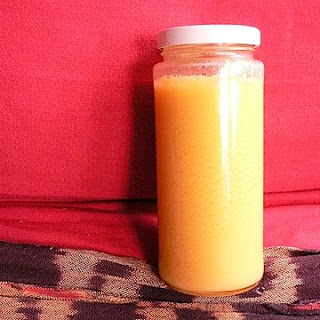
Last summer I worked at the Slow Food festival in San Francisco for a friend of mine, Peter, who makes Ghee. Ghee is made from butter, which is boiled for several hours until all of the milk solids settle to the bottom and eventually burn off. What is left is ghee. It is lactose free, easy to digest and delicious. I was deeply immersed in ghee for 3 days- selling it, talking about it, cooking with it and eating it. In that time I learned a lot from Peter, who is an Ayurvedic doctor and a magnificent story teller. By the end of the festival I was so hooked on the magnificence of ghee I was eating it with a spoon!
"This is the secret name of ghee:
'Tongue of the gods', 'navel of immortality'.
We will proclaim the name of ghee;
We will sustain it in this sacrifice by bowing low.
These waves of ghee flow like gazelles before the hunter...
Streams of ghee caress the burning wood.
Agni, the fire, loves them and is satisfied." - The Rig Veda


For thousands of years in India life revolved around ghee. It was used in cooking to increase the flavor and nutritiousness of food, as a medium for herbs and medicines to make them more absorbable, on the skin as a moisturizer and protector, as an offering of grace to the gods, and in temple lamps, which are said to emit the most beautiful light in the world. The light of burning ghee is said to ward off negativity and evil influence. Throughout the texts of ancient India are stories of the gods fighting over this divine, life-giving substance. It is described in the Vedas how ghee is believed to be the source of the entire universe. Before the world was created there was only a vast sea of matter. It was only after this undifferentiated mass was churned, like butter, that the world took form.

Milk is considered divine because is made entirely from the sap or 'life blood' of plants- which are made entirely from sunlight. Milk is then condensed into butter- which is about 80% fat, and 20% milk solids and water. This is then condensed further to make ghee. So ghee is essentially condensed sunlight!!!
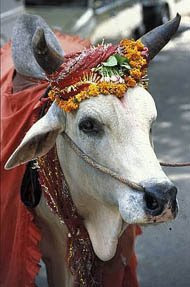
In Ayurveda, ghee is viewed as completely satvic, meaning that it is deeply cooling and balancing. It tonifies the tissues and organs and is slightly cleansing. It is the ideal cooking oil because it can be heated to high temperatures, but won't burn or turn into a trans fat the way olive oil will.

When ghee is massaged into the skin, it bypasses the digestive system and allows the qualities of ghee to penetrate directly into the deeper tissues. It is said that sixty per-cent of what is placed on the skin is absorbed into the body. We literally ‘eat’ what we put on our skin.

It is imperative that one eats only organic ghee. Non-organic ghee contains a concentrated amount of any hormones, or pesticides or antibiotics that were in the milk. The fat we consume becomes stored in our tissues and cells, therefore unlike for instance, non-organic lettuce, which may contain some pesticides, but will largely pass through the system, any hormones or pesticides in fats will be stored in the body.


Ghee is delicious in almost any way you would use butter. Look for ghee (or butter) with the brightest yellow color, because this will indicate how much green, fresh grass the cows had access to. Peter's ghee is Ancient Organics. It is made from Strauss butter- which was voted the best in world, (but I happen to know that the butter my father makes is actually the best!) Strauss's butter is excellent because they have mostly Jersey cows, which produce milk higher in beta-carotene than normal Holstein milk cows (the black and white cows). Also their cows are roaming around the hills of Marin eating grass, so you will notice in the winter the butter will be a slightly deeper yellow color because the cows are eating greener grass!

My dad uses Guernsey cows, which are even better than Jerseys. (The reason everyone doesn't use Guernsey or Jerseys is because, although their milk is better, they produce significantly less of it). He molds it in old, wooden butter molds and tops it with a clover!


You can make your own ghee if you feel inspired. It is important to use the best unsalted, organic butter you can find.
In fact you can make your own butter too.....or milk your own cow...but that's considerably more work....

RECIPE:

1 pound unsalted butter

Put the butter in a heavy, medium-sized pan. Turn the heat on to medium until the butter melts.

Turn down the heat until the butter just boils and continue to cook at this heat. Do not cover the pot. The butter will foam and sputter while it cooks. As it boils, moisture evaporates off and it will begin to clarify and the butter will turn from cloudy yellowish liquid to a more golden color. Whitish cloudy milk solids will rise to the top and sink to the bottom. Do not stir. After a half hour an hour your ghee will be ready. The ghee will be a clear beautiful golden color with a wonderful smell that some have compared to popcorn. The moment ghee is ready is critical and lasts only a short time. If the ghee is cooked too little, moisture will remain in the ghee and it will lack in exquisite taste and qualities. Also, because of the moisture, it will tend to spoil or sour. If ghee is cooked too much, it will burn, turn slightly darker and have a certain nutty flavor. After the ghee is ready, skim off the top light crust of whitish milk solids. Whitish curds will begin to form on the bottom of the pot. Keep a close watch on the ghee, as it can easily burn. After a while it will become a clear, golden color. You will have to take a clean, dry spoon to move away some of the foam on top in order to see if the ghee is clear all the way through to the bottom. Let it cool until just warm. Pour it through a fine sieve or layers of cheesecloth into a clean, dry glass container with a tight lid. Discard the curds at the bottom of the saucepan.
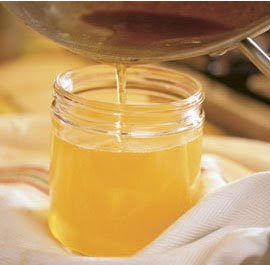
Ghee can be kept on the kitchen shelf, covered. It does not need refrigeration. The medicinal properties are said to improve with age. Don’t ladle out the ghee with a wet spoon or allow any water to get into the container, as this will create conditions for bacteria to grow and spoil the ghee.

Two pounds of butter will fill a quart jar with ghee.

Peter talked a lot about the atmosphere that the ghee was made in. He makes it in the traditional method- only on the waxing or full moon, while singing traditional mantras- you don't have to do this though!

Wednesday, December 3, 2008

Vata Kitchadi


With the post-thanksgiving sluggishness that seems to invariably set-in around this time of year, I thought I would post a recipe for kitchadi (pronounced "kitchari"). Kitchadi is a a simple, nourishing dish that is good for gentle cleansing, or whenever your digestion is a bit "off".

Ayurveda, the sister-science to yoga, teaches that there are three "doshas" or primary elements that manifest as mind-body types- vata, pitta and kapha. From the Ayurvedic perspective everything must be digested- everything we see, experience or in anyway take into our being, must be processed. If food isn't properly digested it creates what is called "ama"- or toxins. If an experience isn't properly digested, we call it trauma.

In order to properly digest our food, there needs to be a strong digestive fire burning. This fire which you feel when you're really hungry or when you eat something and feel full of energy afterwards because the fire is burning cleanly, can periodically become low, or even go out. This often happens after over-eating (i.e. after Thanksgiving!) In this case you have to build the fire back up slowly- starting with kindling and working up to bigger logs. Kitchadi is perfect kindling!

Kitchadi is complete comfort food- it balances all three doshas. It is particularly beneficial for the stomach, lungs, liver, and large intestine. Mung beans are also revered for their detoxification properties. It is very gentle on your system, and can be eaten for an extended period of time to gently detoxify your system (I recently ate pretty much only kitchadi for an entire month).

Here white basmati rice is used because it is easier to digest. Similarly, split-hulled mung beans are used. Unhulled green split mung beans are pretty readily available, but to find hulled, yellow ones, you usually have to go to Indian markets. The green ones work fine though.

Here is a basic recipe that will serve about 4 people. It is especially good at this time of year (the time when Vata is most imbalanced due to the cold and the wind).


RECIPE:

1 cup white basmati rice
1/2 cup yellow split mung dal
3 tablespoons ghee
1 tsp cumin
1 tsp ground coriander
1 tsp black mustard seeds
1 inch fresh ginger, peeled and finely chopped
1/2 tsp turmeric
black pepper to taste
1 piece of kombu seaweed (optional- helps make beans more digestible)
1 small handful shopped cilantro leaves
5 cups water

Wash the rice and the dal twice using plenty of water. If you want to make the kitchadi even more digestible, soak the dal for a few hours before hand adding some whey to the water.

Heat the ghee in a large saucepan with a lid. Add the cumin, mustard seeds and coriander and cook until they begin to pop. Then add the washed dal and rice, ginger, turmeric and pepper, kombu and water.
Bring to a boil. Boil for 5 minutes, uncovered, stirring occasionally.

Turn down the heat to low and cover, leaving the lid slightly ajar. Cook until tender- about a half-hour. If you want the kitchadi to be thicker- cook it longer- or you can eat it more like soup.

Top with cilantro and add salt to taste (to increase the detoxifying properties add less, or no salt).
Enjoy and remember not to eat too much! It's just kindling after all!

Saturday, November 22, 2008

Meyer Lemon Roasted Beet Salad


To me, beets are the ultimate autumn vegetable. Their sweet earthiness is supreme comfort. I love them roasted with garlic, or boiled and served with butter and cumin, or blood oranges. They are lovely in a breakfast hash with bacon, or raw, grated in salads.

Beets are incredibly healthy, which makes sense intuitively, since their deep color is so similar in appearance to our blood.
Since Roman times, beet juice has been considered an aphrodisiac. It is a rich source of the mineral boron, which plays an important role in the production of human sex hormones. From the Middle Ages, beets were used as a treatment for a variety of conditions, especially illnesses relating to digestion and the blood. The greens bring an additional set of nutrients to the plate, most notably beta-carotene, vitamin C, iron and calcium, and are delicious steamed and served with butter.

RECIPE:
serves 12
2 lbs red beets
2 lbs golden beets
salt, pepper
2 meyer lemons, zested and juiced.
3 tbsps sherry
1/4 cup olive oil
6 endive
1/2 lb baby arugula or watercress
fresh chives
dried tarragon
1 cup toasted walnuts
goat cheese or blue cheese- 1 cup or so, crumbled

Preheat the oven to 425 degrees. Cut the greens away from the beets, leaving about 1/4 inch of stems. Scrub the beets, dry them, and then rub them in olive oil, salt and pepper and lemon zest. Then place them in the middle of a large sheet of tin foil and close to make a pocket. Place on cookie sheet and bake for about an hour or until tender to a fork. When done, remove skins and chop the beets.

Make the dressing, by whisking together the sherry, lemon juice, olive oil, tarragon and chives.

Pour the dressing over the beets and mix well. Add the chopped endive and arugula or watercress and mix again, gently. Add the nuts and cheese and some fresh ground pepper, and enjoy.

The beets can be roasted a day or two before using, also the nuts can be roasted before hand. Even the dressing could be made a day ahead if you were really trying to be efficient.